
Food and beverage industry set to grow worldwide
The food and beverage industry is one of the largest manufacturing sectors in terms of jobs and value added in most economies contributing US$77.5 trillion globally in 2017. A forecast overall CAGR of 2.9% over 2017-30 is driven in part by population growth in emerging markets within Asia Pacific and Middle East and North Africa but also by the shift to packaged and convenience foods in these regions.
In 2017, total global disposable income accounts for the 65% of total world GDP (US$51 trillion in 2017) while consumer expenditure represents 56% of world GDP. Consumer expenditure on food and beverages is now US$6.6 trillion or 8.5% of world GDP.
Asia Pacific is forecast to achieve the fastest growth in GDP, driven by the strong manufacturing and export-led economies of China and India as well as overall growth in private consumption. Growing private consumption in these markets is encouraged by the expansion of global foodservice chains introducing westernised food and beverages as well as the expansion of modern retailing formats and the raised presence of convenience products.
GDP growth in Europe is more muted, with mature, saturated markets for food and beverages. Valueadded products are favoured by higher income and older consumers looking for natural ingredients/product formulations that exclude added sugar, salt, preservatives and artificial ingredients. With up to 24% of the population of Europe expected to be over 65 years by 2030, food and beverages in smaller quantities, with natural flavours and clear labelling are expected to be in higher demand. Rising incidences of diabetes, cardiovascular diseases and osteoporosis will drive the growth of functional foods fortified with vitamins and minerals.
After the latest recession, and political and economic uncertainty, consumers in many countries have adopted a more cautious approach to spending. Consumers in developing markets tend to be more optimistic than those in developed counties when it comes to spending but many still focus on affordability as the primary purchase decision criteria.
 Demand for fast food restaurants and processed food in Nigeria is robust, fuelled by a fast-growing young population, rapid urbanisation, increasing affordability and demand for convenience
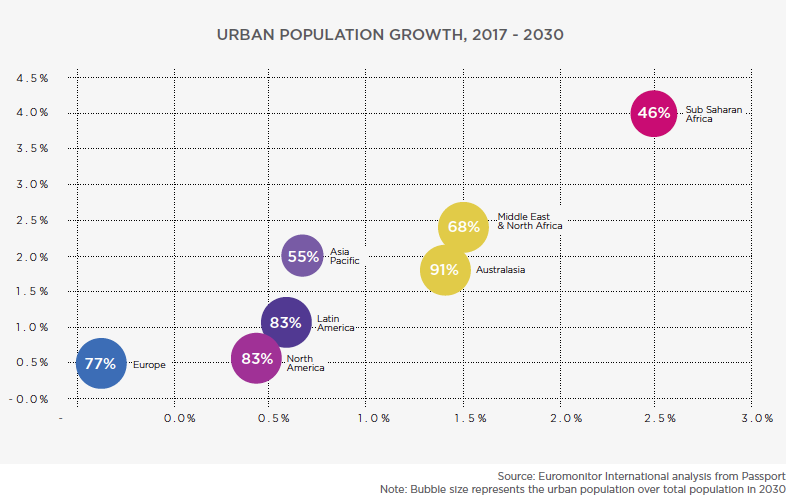
As disposable income rises, consumer expenditure on food and beverages in the Asia Pacific and Middle East and Africa regions will increase from 53% of global expenditure in 2017 to 60% by 2030. Urbanisation and population growth are expected to aid this consumer spend. As a result, packaged foods and beverages are expected to become more accessible, with increased access to international brands and western food types.
In developed markets consumers are more inclined towards purchasing added-value products, preferably with natural ingredients, Plant-based and alternative More than half of world GDP now comprises consumer expenditure In 2017, total global disposable income accounts for the 65% of total world GDP (US$51 trillion in 2017) while consumer expenditure represents 56% of world GDP. Consumer expenditure on food and beverages is now US$6.6 trillion or 8.5% of world GDP.
Forecast growth in middle-class households is strongest in countries such as Nigeria and Egypt as employment and income opportunities rise in urban areas in these countries. Expenditure on food and beverages also increases at a high rate as these middle-income households emerge.Demand for fast food restaurants and processed food in Nigeria is robust, fuelled by a fast-growing young population, rapid urbanisation, increasing affordability and demand for convenience. In addition, Nigerians are switching from unpackaged, unbranded products to packaged products as the urban population reaches 51% and consumers look for packaged food products that are quick to prepare or ready to consume, such as noodles, dairy products, snacks and bread.
In North America, the population aged 60 years and older constitutes the fastest-growing consumer segment in both the USA and Canada. This is expected to drive increased demand for a wide range of agespecific products and services, particularly health-related products. Many people are working longer than previous generations, have higher disposable incomes and have an active, healthy lifestyle. Manufacturers, aware of consumer demand for natural, nutritional and sustainable foods, are reformulating their popular products to increase appeal, achieving market share by acquisition of smaller, successful, niche providers and developing fresher products with natural ingredients and lower levels of processing that suit not just the older generation but also strong health trends throughout the general population.
 In Western Europe, the free-from trend is now well established and growing. Gluten-, meat- and dairy-free product ranges are increasing in variety, availability and affordability as the price gap between standard and free-from products narrows. Flexitarian, vegetarian and vegan populations are growing, but even among general consumers there are many who believe that gluten- or lactose-free products are good for digestion and that alternative high-protein sources are kinder to the environment as well as better for your health. In the UK, for example, sales of free-from packaged foods grew by 5% in 2016 as sales through supermarkets, hypermarkets and discounters expanded.
In Turkey, 75% of all households are now in urban areas. Many adults are in professional employment and there has been a rise in the number of single person households. This has created demand for smaller-sized packs, processed meat and ready meals, with convenience and ease of preparation high on the agenda for busy working adults. Young, urban consumers are interested in new and sophisticated products for in-home consumption, as general political and economic instability has depressed the frequency of eating out. Western-style coffees and health and wellness products, such as fruit/herbal and green tea, are increasingly popular.
Economic recession and trade embargos on Russia are heightening price sensitivity. Consumers are trading down with a shift from premium to mid-priced or mid to economy price segments, for example in tea, coffee and hot drinks. Manufacturers are responding by diversifying their product portfolios offering value for money lines at all price points as well as using promotional activity to maintain visibility and brand loyalty. Domestically produced drinks such as Russian kompot juice drinks, kvass non-cola carbonates or sugar-free and vegetable-based soft drinks are widely available and popular.