

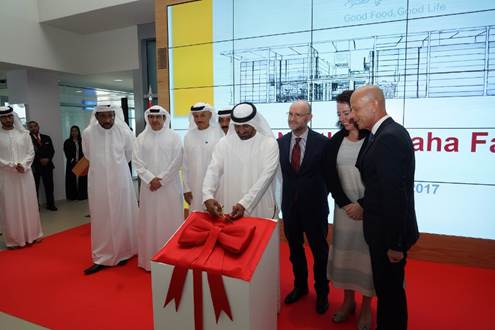
Nestlé Middle East Inaugurates Al-Maha Factory in Dubai South
folder_open Foodstuff Market , Industry Reports , News
Dubai, 16 May 2017: Nestlé Middle East’s 18th factory in the region has been inaugurated in Dubai South by His Highness Sheikh Ahmed Bin Saeed AL Maktoum, President of the Dubai Civil Aviation Authority, Chairman Dubai Airports, and Chairman & Chief Executive Emirates Airlines & Group; and in the presence of Marco Settembri, Executive Vice President Nestlé SA and Head of Zone Europe, Middle East and North Africa. “Dubai South offers strategic advantages that make it an ideal and attractive destination for leading multinationals,” said H.H Sheikh Ahmed. “It is an important component in Dubai’s vision to provide a comprehensive platform that caters to the needs of aviation, air transport, commercial, and logistics businesses.” “Nestlé has been the early mover to Dubai South having realized its potential as the economic platform for the future. They have leveraged our excellent infrastructure and ease of doing business to further grow their business. We’re delighted to see Nestlé growing stronger in the region,” said H.E. Khalifa Al Zaffin, Executive Chairman of Dubai Aviation City Corporation and Dubai South. “The Al-Maha factory underlines our commitment to our customers, our willingness to invest and create jobs, and our ambition to minimize our environmental impact,” said Marco Settembri. “This US$ 145 million investment is Nestlé’s 18th production site in the Middle East and another milestone in our more than 80 years in this region. It shows our confidence in Dubai and the United Arab Emirates as a dynamic, stable and competitive business hub, and our long-term commitment to the people of the Middle East.” The new factory employs 340 men and women stemming from 20 different nationalities. Sixty percent of the team is under 30 years old. Nestlé already operates two other factories in Dubai Investment Park, one for Nestlé Waters, and another – Nestlé Dubai Manufacturing – covering KITKAT, MACKINTOSH’s Quality Street, and NIDO products. “Nestlé Al-Maha is yet another way for us to meet our commitment to the Middle East,” said Yves Manghardt, Chairman and CEO Nestlé Middle East FZE. “Manufacturing locally enables us to source locally, invest locally, make tailored products to better meet local needs, and serve communities in the region more rapidly and more effectively.” The new factory has already achieved outstanding results with regards to safety, with zero accidents during the construction period. It also met the stringent Nestlé quality standards from the very first production run. Nestlé Al-Maha holds the Halal certification of the Emirates Authority for Standardization and Metrology (ESMA). It runs on 100% LED lighting, which consumes nominal energy, is fully insulated to save air-conditioning energy, recycles 100 per cent of waste from products and raw materials, reaching zero waste for landfill, implements water saving mechanisms, and has an ambition to operate on solar-generated power. The Factory also includes a permanent exhibit, showcasing the role Nestlé plays in society. Some examples in the Middle East are the Nestlé Healthy Kids Program – Ajyal Salima, now in five countries in the region where it has reached over 40,000 children to date; and United for Healthier Kids that has mobilized so far over 580,000 joiners to nurture healthier generations. The exhibit also features high-tech tools; including iPads and Oculi, allowing 360-degree virtual visits of farms around the world from which raw material is sourced for products. It also provides special presentations for students on site, and offers digital guides for career development and enhancement for Youth. [alert color="green" type="alert-message-background" title="About Nestlé Middle East" size="big"]Nestlé Middle East’s heritage goes back 80 years to 1934 when the first import operation was set up in Lebanon. Today, Nestlé Middle East owns and operates 18 factories and provides direct employment to more than 11,000 employees who are all committed to Nestlé’s purpose of enhancing quality of life and contributing to a healthier future. It also provides indirect employment to several thousand more. The Nestlé portfolio in the region currently exceeds 60 innovative product brands in a wide range of categories: dairy products and infant nutrition, bottled water, chocolate and confectionery, coffee creamers, breakfast cereals, and culinary products, among others. Nestlé Nido, Nestlé NAN, S-26, Progress, Maggi, Nescafé, Kit Kat, Coffeemate, Nestlé Cerelac, Nestlé Pure Life, Nespresso and Nestlé Fitness are just some of the brands available in the Middle East.[/alert]
Demand for foodstuff in Africa to grow due to rapid urbanisation
folder_open Foodstuff Market , Industry Reports
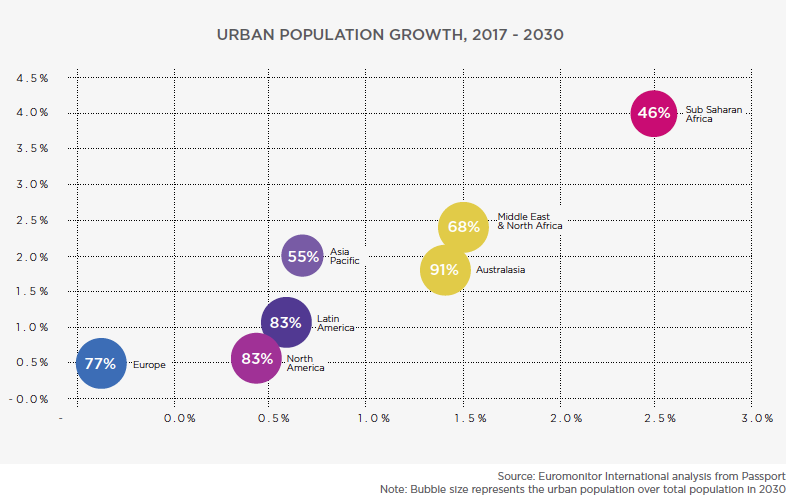
By 2030, 60% of the total world population will be living in urban areas. Urbanisation offers a dense, concentrated market and opportunities for retail infrastructure and products tailored to newly affluent consumers as well as large sections of the community on low incomes. Growth in urbanisation is expected to surpass overall population growth in all regions. High urbanisation growth, as demonstrated in Sub-Saharan Africa, offers potential as new cities coalesce around natural growth in the population, migration from rural areas and reclassification/upgrading of former slums into urban areas. Urbanisation growth in the Middle East & North Africa region is also expected to be strongly influenced by large-scale infrastructure development, agricultural and land reform and the development of older and new cities. Growing urbanisation in these regions influences demand for food and beverage categories differently. Demand for higher-priced convenience categories such as RTD tea and coffee and higher-grade olive oils is greater in the Middle East and North Africa due to higher disposable income levels while more mass market products, such as beverages (bottled water, packaged tea) and dairy products are in greater demand in Sub-Saharan Africa. In Nigeria, staple foods, such as a rice, pasta and noodles, have seen strong growth In Nigeria, urban population has been price sensitive due to economic uncertainty which has forced unit prices for food and beverages to rise strongly in recent years. Staple foods, such as a rice, pasta and noodles, have seen strong growth. Instant noodles, for example, are increasingly popular and are seen as convenient to prepare, fairly cheap, and widely available. Dufil Prima Foods’ Indomie noodles brand is now a market leader as a result of good incentives for distributors, strong below-the-line advertising, frequent consumer promotions, as well as the availability of a variety of pack sizes and flavours. In Manila, one of the most densely populated cities in the world, the importance of product convenience has been prominent to address the demand of the urban population. Companies such as AB Nutribev have found success with their Vitamilk product, available in 300ml glass bottles and positioned as a healthy energy drink that can help address hunger and tiredness. It targets the increasing demand for on-the-go consumption. In 2017, Purefoods-Hormel Co started construction of new production facilities for hotdogs, chicken nuggets, corned beef and luncheon meat in the Philippines to meet demand in the mid-to-high end of the market. Modern retailing in the Philippines is expanding more rapidly than traditional grocery retailing, offering greater opportunities for hot and chilled foods. Highly urbanised societies in Europe create a different profile of product demand. Meat substitutes and hot cereals are examples of key growth categories on the back of strong health and wellness concerns. For example, in the mature and saturated processed meat market in Germany, meat substitutes are now a small but strongly performing category. Meat consumption is changing with a growing number of vegetarians and those following a vegan lifestyle. In addition, many consumers aim to lower their meat consumption as part of a healthy heart lifestyle. This emerging consumer group presents significant opportunities for growth with many meat processors now venturing into this category to ensure full portfolio coverage within this market. Pure discounter Aldi offers a wide range of vegan options including burgers, schnitzel, meatless hotdogs, meatless meatballs, chickenless nuggets and meat-free mince and in December 2017, it launched its range in an additional 17 countries.
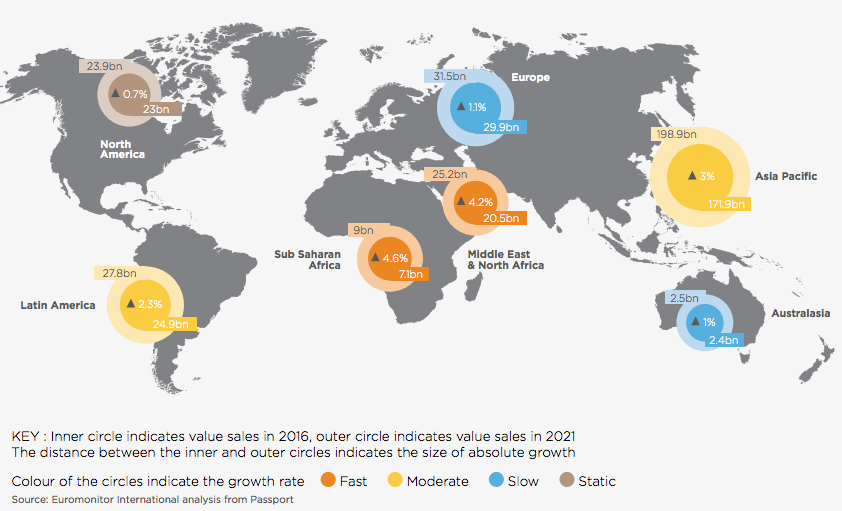
By far the fastest growth in cereals stems from Africa, led by Sub-Saharan Africa, but with the Middle East and North Africa also growing strongly. Total global market value of pulses, grains and cereals reached US$279.7 billion in 2016 and is forecast to reach US$286.4 billion in 2017. In both cases, this is from a small base, led by consumers in lowerincome areas of these regions trading up to packaged versions of staple cereals. In most developed markets, sales of cereals are at saturation point, with little room left for growth. North America, following a decline over the review period, is expected to be stable to 2021. Diversifying diets and moves away from carbohydrate-heavy foods mean these are difficult markets to navigate. Growth prospects come instead in cereals that offer newness and/or healthy options (Asian-style noodle dishes, quinoa-based pasta) or offer added-value convenience (microwaveable rice, chilled pasta and noodle dishes). Breakfast cereals face similar prospects, with a reputation for being unhealthy and due to competition from other convenient options, such as breakfast bars. However, health positioned options such as granolas and mueslis are faring better. Alongside North America, growth is also sluggish in the more developed Western European markets: here maturity combines with trends away from carbohydrate-based meals to create a difficult operating environment. Value growth is supported by rising unit prices. The fastest growth is visible where there is still room to grow in consumption levels of packaged staples and where breakfast cereals are at an earlier stage of development, with a healthier image – this is focused on Sub-Saharan Africa but also includes areas in North Africa, parts of Asia, and Central America. Dynamic growth in Sub-Saharan Africa is the result of consumers trading up to packaged products. In Nigeria, for example, sales of instant noodles are rocketing as they are low priced (in a period of relatively high pricing on imported rice), easil available and convenient to prepare, and are particularly popular among urban families with young children.
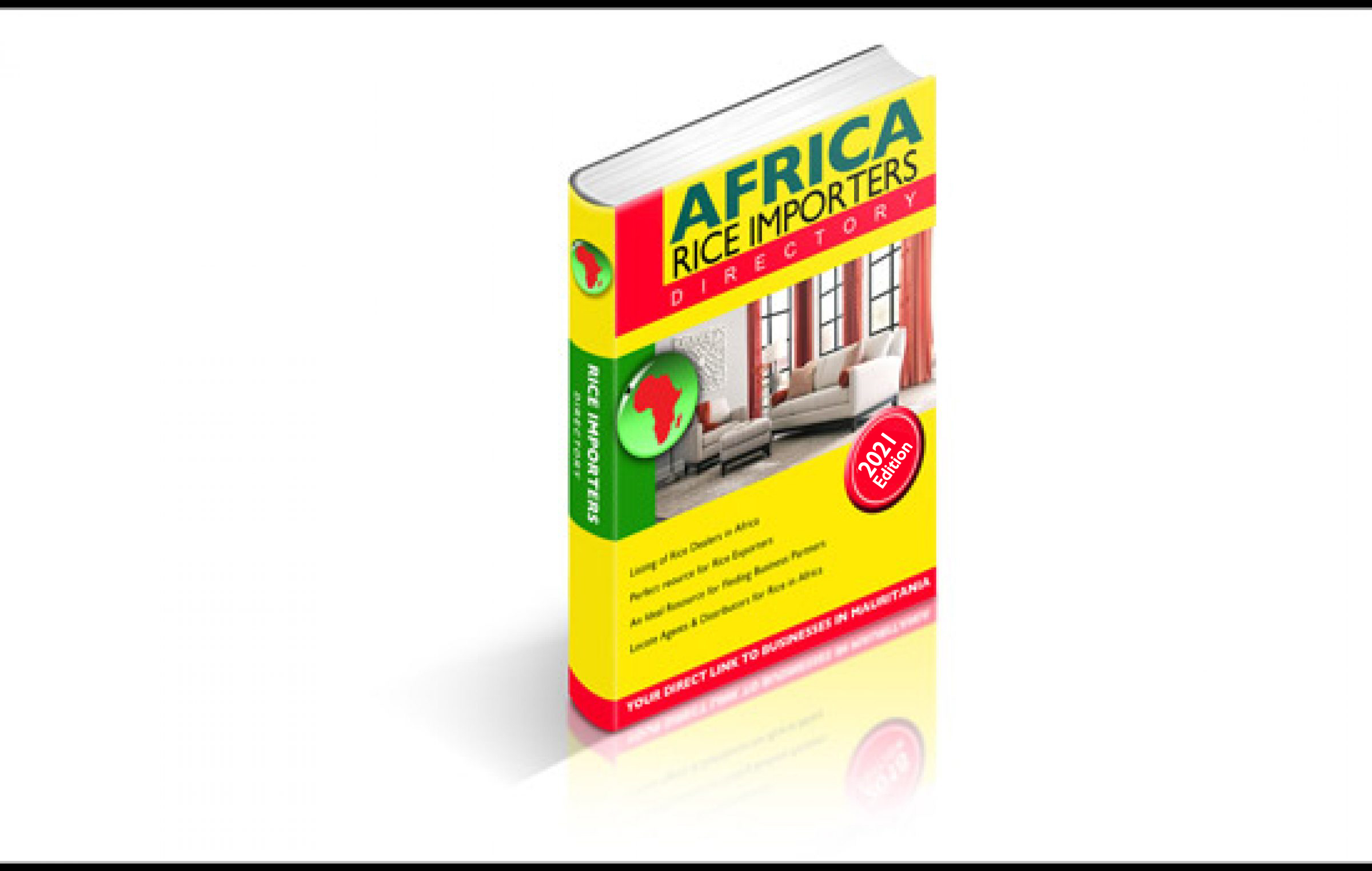
Africa Business Pages, the leading B2B portal connecting African buyers with global suppliers, has compiled a special directory of rice importers in Africa. The Africa Rice Importers Directory lists major rice importers in Africa from over 40 African countries. Rice importers in Africa have been buying ever increasing quantities of rice from all across the world in order to meet the rising demand for rice amongst African buyers. According to industry reports, A frica imported 17 million tonnes in the last five years. Around half of the current global population—or about 3.5 billion people—relies on rice as a source of sustenance and livelihood. As local rice producers in Africa are not able to meet the rising demand for rice, importers of rice have been buying from overseas suppliers to meet the rising demand for rice amongst African consumers. Many African rice importers import a significant amount of rice for local consumption and regional distribution. However, the relatively small country of Benin has emerged as one of the leading rice importers in Africa. Most of the rice imported into Benin is actually destined for Nigeria and is smuggled across the border to bypass the ban on imported rice by the Nigerian government in a bid to promote local agriculture. The Africa Rice Importers Directory has been compiled with the sole purpose of promoting direct B2B contacts between African importers of rice and global suppliers. The Africa Rice Importers Directory provides exporters of rice a comprehensive database of importers of rice in Africa and helps them contact them directly. Online sales as well as email marketing has been playing an ever important role in promoting B2B contacts and generating sales leads – specially so in Africa where other forms of media and promotional tools are not as effective. By compiling a well researched list of rice importers in Africa, the Africa Business Pages has proved once again that it has been leading the pack when it comes to direct B2B promotions in the African markets.
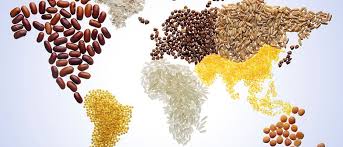
Rice is continuously gaining importance as a staple food in Africa. While Africa has vast areas of land that are suitable for rice cultivation, they are underutilized, prompting the African markets to import nearly 40% of its rice requirements at a cost of approximately US$1.1 billion per year. India, the world’s biggest rice exporter, saw 5% broken parboiled rice rise $7 per tonne to $352 to $357 per tonne, as aggressive purchases by the government and exporters pushed prices of unmilled rice in the local market. Rice prices in India have been increasing as demand from African buyers continues to grow and government agencies and exporters have been buying rice from local farmers in large quantities, while export markets in Thailand and Vietnam have been quiet due to the absence of many African buyers of rice. Rice importers in Africa have bought more rice from Myanmar and about 60 per cent of rice carried from sea routes are exported to Africa. Myanmar Rice Federation (MRF) is expected to export about three million tonnes of rice in 2020. China is now the top producer, top consumer, top stockholder, top importer and a “rising exporter” of rice. Almost two-thirds of Chinese rice exports were to Africa. Meanwhile, the amount of rice Thailand has been exporting, especially to Africa, has dwindled, as Thailand is left with only the no-longer-good-for-human consumption rice within the country’s domestic stocks. The rapid growth in sales to African nations is expected to continue as African buyers increasingly turn to China as stockpiles are almost depleted in rival supplier Thailand. China sold just over 781,000 tonnes of rice to almost 40 African countries including Ivory Coast and Senegal in 2017. That accounted for nearly 70 percent of China’s total shipments of the commodity, versus 19 percent in 2016. China has around 94 million tonnes of rice stockpiles, two-thirds of the world’s excess inventory and enough to feed India for a year. A lot of that was accumulated through years of the government buying the grain from farmers at a minimum price when the market price dropped below that level. Tanzania’s has recorded a 20% increase in rice imports from Pakistan valued at US$29.6 million between July and December 2017. With the growing demand for rice especially in urban areas, Tanzania is the major producer and supplier of rice in the region, while Kenya and Uganda are minor producers. Tanzania is set to overtake Madagascar to become the leading grower of rice in Africa, having produced over one million tonnes of rice per annum, coming second to Madagascar’s yearly output of 4.3 tonnes. Pakistan targets to export four-million-tonne rice annually to fetch US$2 billion in foreign exchange mainly driven by Chinese cooperation with the government and private sector in the field. Despite the fact that Tanzania is a major rice producer and exporter, it ranks number eight on the list of importers of the rice during the period and the third top African market after Kenya, which is ranked second and Madagascar in the fourth position. While Madagascar spend US$51.7 million, Kenya spend as high as US$98.6 million to buy rice from Pakistan, with Benin and Somalia also projected on the list of top importers from Africa. Zimbabwe is a net importer of rice and spends about $80 million annually to import the cereal. The rapid acceleration in per capita rice consumption in Africa since the mid-1990s is due to the liberalization of rice imports combined with a downward trend of the price on the international market.
Kenyan food manufacturer Ariel Foods targets Nigerian market
folder_open Foodstuff Market , Industry Reports
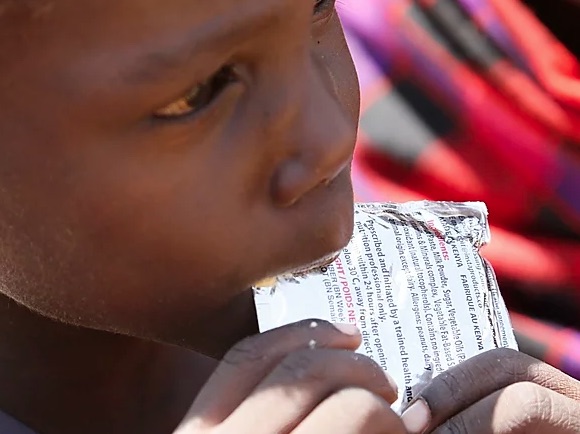
Ariel Foods, a renowned Kenyan therapeutic foods manufacturer famous for its food supplements for malnourished people worldwide is expandeding its operations in West Africa through its base in Nigeria seeking. The food company aims to tap into the wider West African market through its operations in Nigeria. Insta’s therapeutic foods are a high calorie combination of peanut paste, sugar, oil and milk powder which is fortified with 23 vitamins and minerals. Severely malnourished people, who cannot digest solid food portions or receive supplements intravenously, feed on the supplement for six weeks before progressing to other foods. Insta Products has been operating for 16 years. Its products are distributed regionally but they are also shipped to needy individuals in countries such as Afghanistan, Syria, Pakistan and Yemen among others places, Ariel Foods’ new Nigerian factory will be set up in Alaro City, a mixed-income development featuring industries, logistics, offices and homes in Lagos State. The city is backed by Rendeavour, Tatu City’s owner and developer. Rendeavour is also developing other similar cities in Africa including two in Ghana at King City and Appolonia, Kiswishi in the Democratic Republic of the Congo and Roma Park in Zambia. “Ariel Foods is proud to expand its production to Nigeria, and to play a major role in food and population security in West Africa through the production of ready-to-Use therapeutic foods to feed malnourished children and to supplement the diets of persons with special nutrition requirements,” said Dhiren Chandaria, owner of Ariel Foods. Chandaria also owns Kenya-based Insta Products which is a major supplier to UNICEF and World Food Programme relief initiatives. Lagos State Governor Babajide Sanwo-Olu welcomed the Kenyan firm’s investment. “I am pleased to witness the start of operations of Ariel Foods, which has built a remarkable facility in less than one year,” he said. “The confidence of international and Nigerian investors is a testament to Alaro City as the location of choice for businesses in the Lekki Free Zone, and to the ease of doing business in Lagos State.” Insta, located in Athi River’s Export Processing Zone, produces food supplements for malnourished people. Ariel Foods, a renowned Kenyan therapeutic foods manufacturer famous for its food supplements for malnourished people worldwide is expanding its operations in West Africa through its base in Nigeria seeking. The food company aims to tap into the wider West African market through its operations in Nigeria. Insta’s therapeutic foods are a high calorie combination of peanut paste, sugar, oil and milk powder which is fortified with 23 vitamins and minerals. Severely malnourished people, who cannot digest solid food portions or receive supplements intravenously, feed on the supplement for six weeks before progressing to other foods. Insta Products has been operating for 16 years. Its products are distributed regionally but they are also shipped to needy individuals in countries such as Afghanistan, Syria, Pakistan and Yemen among others places, Ariel Foods’ new Nigerian factory will be set up in Alaro City, a mixed-income development featuring industries, logistics, offices and homes in Lagos State. The city is backed by Rendeavour, Tatu City’s owner and developer. Rendeavour is also developing other similar cities in Africa including two in Ghana at King City and Appolonia, Kiswishi in the Democratic Republic of the Congo and Roma Park in Zambia. “Ariel Foods is proud to expand its production to Nigeria, and to play a major role in food and population security in West Africa through the production of ready-to-Use therapeutic foods to feed malnourished children and to supplement the diets of persons with special nutrition requirements,” said Dhiren Chandaria, owner of Ariel Foods. Chandaria also owns Kenya-based Insta Products which is a major supplier to UNICEF and World Food Programme relief initiatives. Lagos State Governor Babajide Sanwo-Olu welcomed the Kenyan firm’s investment. “I am pleased to witness the start of operations of Ariel Foods, which has built a remarkable facility in less than one year,” he said. “The confidence of international and Nigerian investors is a testament to Alaro City as the location of choice for businesses in the Lekki Free Zone, and to the ease of doing business in Lagos State.” Insta, located in Athi River’s Export Processing Zone, produces food supplements for malnourished people. Insta, located in Athi River’s Export Processing Zone, produces food supplements for malnourished people.
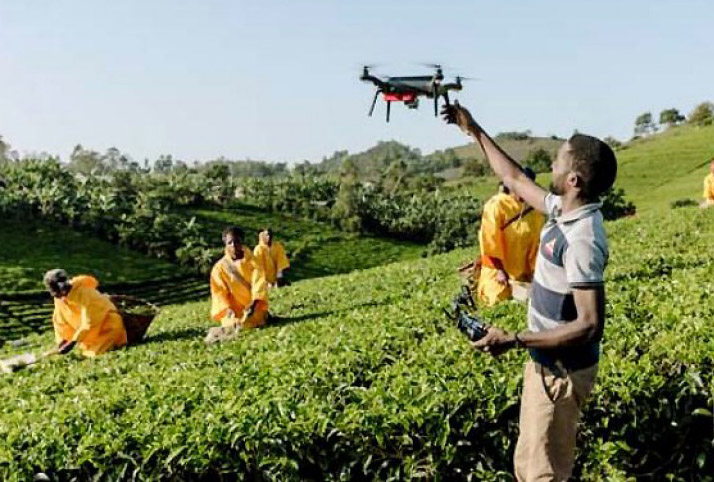
Farmers in Africa and agri-businesses sector in Africa could be worth a trillion-dollars by 2030 if given proper access to more capital, electricity, better technology and irrigated land to grow high-value nutritious foods, and if African governments can work more closely with agribusinesses to feed the region’s fast-growing urban population, according to a new World Bank report. According to the Growing Africa: Unlocking the Potential of Agribusiness report, Africa’s food systems, currently valued at US$313 billion a year from agriculture, could triple if governments and business leaders radically rethink their policies and support to agriculture, farmers, and agribusinesses, which together account for nearly 50 percent of Africa’s economic activity. “The time has come for making African agriculture and agribusiness a catalyst for ending poverty,” says Makhtar Diop, World Bank Vice President for Africa region. “We cannot overstate the importance of agriculture to Africa’s determination to maintain and boost its high growth rates, create more jobs, significantly reduce poverty, and grow enough cheap, nutritious food to feed its families, export its surplus crops, while safeguarding the continent’s environment.” Agribusiness in Africa: Growth Prospects Due to a combination of population growth, rising incomes and urbanization, strong demand is driving global food and agricultural prices higher. Supply issues – slowing yield growth of major food crops, slowdown in research spending, land degradation and water scarcity issues, and a changing climate all mean that prices will remain high. In this new market climate, Africa has great potential for expanding its food and agricultural exports. Africa holds almost 50 percent of the world’s uncultivated land which is suited for growing food crops, comprising as many as 450 million hectares that are not forested, protected, or densely populated. Africa uses less than 2 percent of its renewable water sources, compared to a world average of five percent. Africa’s harvests routinely yield far less than their potential and, for mainstay food crops such as maize the yield gap is as wide as 60 to 80 percent. Post-harvest losses run 15 to 20 percent for cereals and are higher for perishable products due to poor storage and other farm infrastructure. African countries can tap into booming markets in rice, maize, soybeans, sugar, palm oil, biofuel and feedstock and emerge as major exporters of these commodities on world markets similar to the successes scored by Latin America and Southeast Asia. For Sub-Saharan Africa, the most dynamic sectors are likely to be rice, feed grains, poultry, dairy, vegetable oils, horticulture and processed foods to supply domestic markets. The report cautions that even as land will be needed for some agribusiness investments, such acquisitions can threaten people’s livelihoods and create local opposition unless land purchases or leases are conducted according to ethical and socially responsible standards, including recognizing local users’ rights, thorough consultations with local communities, and fair market-rate compensation for land acquired. “Improving Africa’s agriculture and agribusiness sectors means higher incomes and more jobs. It also allows Africa to compete globally. Today, Brazil, Indonesia and Thailand each export more food products than all of sub-Saharan Africa combined. This must change,” says Jamal Saghir, World Bank Director for Sustainable Development in the Africa Region. Value Chains in Africa Rice: Africa has become a major consumer and importer of rice, and Africans import half the rice they eat and pay top dollar for it, $3.5 billion per year and more. Ghana and Senegal are significant importers. Senegal is competitive among its neighbors, but it is held back by the difficulty farmers have in accessing land, capital, finance for irrigation expansion and appropriate crop varieties. Ghana produces fewer varieties of rice than Senegal, but at significantly higher cost, and levies 40 percent tariffs and other charges on imports. Poor grain quality, cleanliness and packaging are major deterrents for consumers constraining the sector’s performance. Maize: A food staple for many Africans, maize is grown on 25 million hectares or 14 percent of cropped land. In Zambia where people eat on average 133 kilograms of cereals a year, maize provides half the calories in their diets. Zambia is competitive when importing maize but fails on exports. High transport costs, higher labor costs and lower yields combine to increase costs by one-third compared to Thailand, a major international producer of rain-fed maize. The report argues that Zambia’s future competitiveness depends on raising yields, reducing costs, and removing disincentives for the private sector in markets and trade. In addition, the study reviewed value chains for cocoa in Ghana and dairy and green beans in Kenya. “African farmers and businesses must be empowered through good policies, increased public and private investments and strong public-private partnerships,” says Gaiv Tata, World Bank Director for Financial and Private Sector Development in Africa. “A strong agribusiness sector is vital for Africa's economic future.” Agriculture Sector in Africa Agriculture and agribusiness should be at the top of the development and business agenda in Sub-Saharan Africa. The report calls for strong leadership and commitment for both public and private sectors. As comparators, the report cites case studies from Uruguay, Indonesia and Malaysia. For success, engaging with strategic “good practice” investors is critical, as is the strengthening of safeguards, land administration systems, and screening investments for sustainable growth. Africa can also draw on many local successes to guide governments and investors toward positive economic, social and environmental outcomes.
Preliminary request for participation in the trade show
place
calendar_today
Preliminary request for visitor registration
Visitor Registration
place
calendar_today